
Zambia by birdsong
A field journal on birding in South Luangwa and the Lower Zambezi. Carmine bee-eater season, African skimmers, Pel's fishing owl, and what birds do to a safari when you let them.

# Zambia by birdsong
Zambia holds more than 750 recorded bird species, with South Luangwa and the Lower Zambezi between them accounting for the bulk of what most travellers will see. From August to October, carmine bee-eaters nest in vast crimson colonies along the Luangwa's sandy banks, one of Africa's most dramatic wildlife events. The Lower Zambezi adds a different birding texture entirely, water-level encounters with African skimmers, malachite kingfishers and the elusive Pel's fishing owl, accessed by canoe and boat as much as by vehicle. A combined trip across both parks typically runs eight to twelve nights, and August is the start of the best window for either.
A morning on the riverbank
It is half past six in August on the Luangwa River, and the bank ahead of us is on fire.
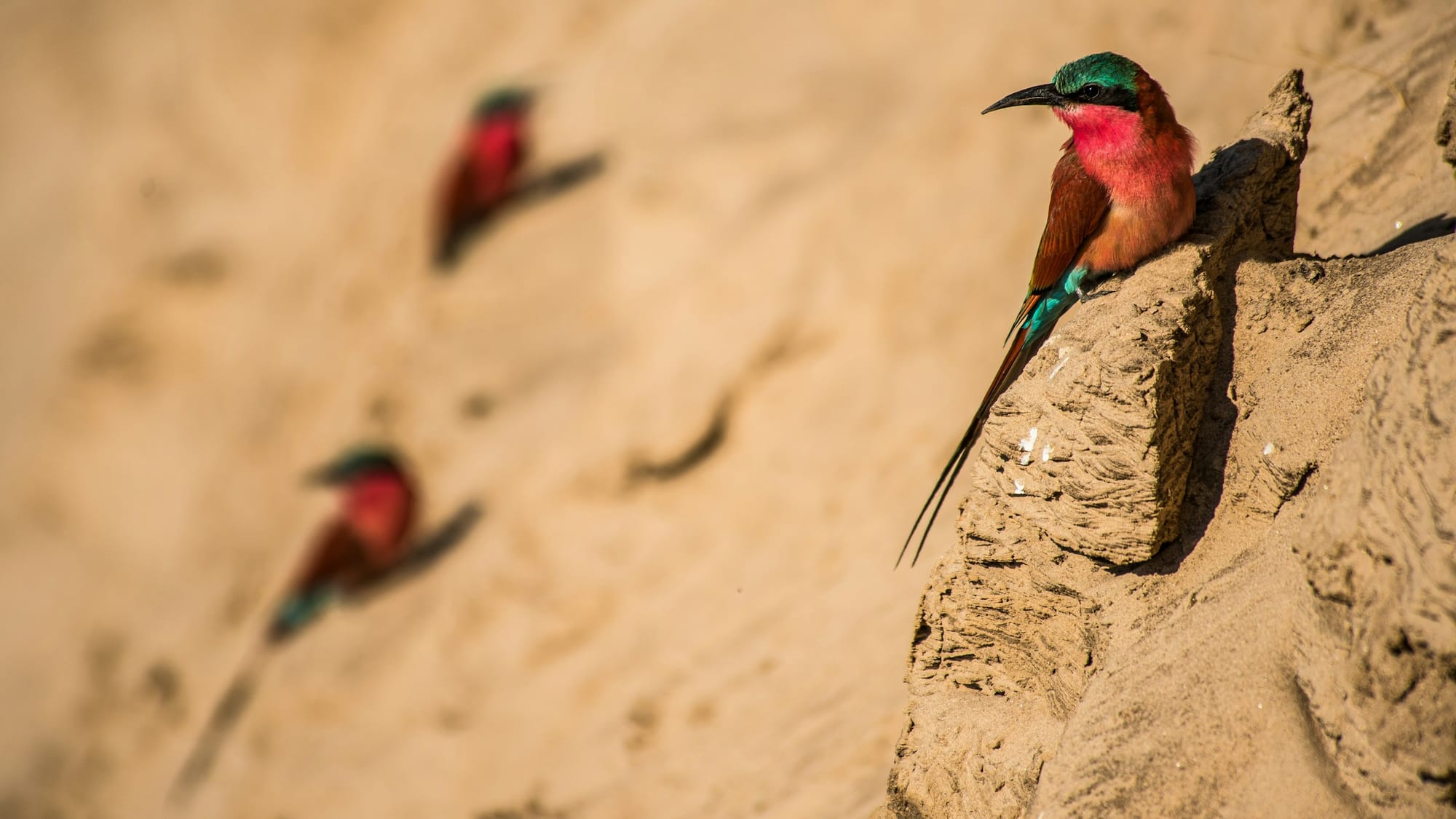
Not actually. What the bank is doing is breathing in and out with thousands of southern carmine bee-eaters, arriving in waves from somewhere downriver, settling, lifting, settling again. They have flown here from further north in Africa to breed. The males have already started carving nesting tunnels into the exposed sandbanks. The colony will hold thousands of pairs at peak, and from the water you can hear the colony before you see it, a sound that is not quite a hum and not quite a murmur, a kind of weather of voices.
We turn the engine off. The guide picks up a small spotting scope and rests it on the gunwale. He does not say anything. After a minute he points, and in the scope there is a single bird halfway through hollowing out its tunnel, sand showering off the bank in a fine veil.
This is what it sounds like when a safari slows down.
What birds do to a trip
There is a version of safari that stays at sixty kilometres an hour with the radio chatter on, looking for big cats. It is a good version. We design it for guests who have one week and want to see a leopard. The animals are real, the sightings are real, and the trip works.
There is another version that operates at a different speed. You stop the vehicle for a saddle-billed stork because the guide has noticed it picking through the shallows and you are, today, in no hurry. You walk a riverbank for forty minutes because something is calling that the guide has not heard since last September. You stay out past sundowners because a lilac-breasted roller has caught the last of the light on a dead branch and the photograph wants to happen.
This second version is what birds do to a safari.
You do not have to be a birder for it to work. Most of our Zambia guests are not. They are people who have already done one or two safaris, who have seen the obvious things, and who are now interested in slowing down. Birds are the easiest way to do that. They are everywhere. They reward attention. They give a guide something specific to teach, and a guest something specific to learn, and at the end of a week you know the difference between a fish eagle's call and a wood owl's call, which is a small thing and not a small thing.
South Luangwa: the carmine season
Between August and October, the Luangwa River produces one of the great wildlife events on the continent.
Southern carmine bee-eaters arrive from breeding grounds further north, find the soft sand cliffs that the river cuts each year as it shifts course, and excavate nesting tunnels by the thousand. The colonies sit along exposed banks for several kilometres. At peak, the air over a single colony holds three to four thousand birds in motion at once, a wash of crimson, turquoise and green, and the noise of them is constant.
The best viewing is from a boat, drifting close enough to see the tunnels but far enough to keep the colony settled. The light at first hour and last hour is what you want. The birds are most active early, working the river for dragonflies and other insects in flight, and a guide who knows the colony will position the boat where the morning sun catches them coming back to the bank with prey.
This event happens almost nowhere else on the African continent at this scale. There are smaller colonies elsewhere in southern Africa, but the South Luangwa is the place. If you are travelling in August, September or October and you can route through Mfuwe, you should.
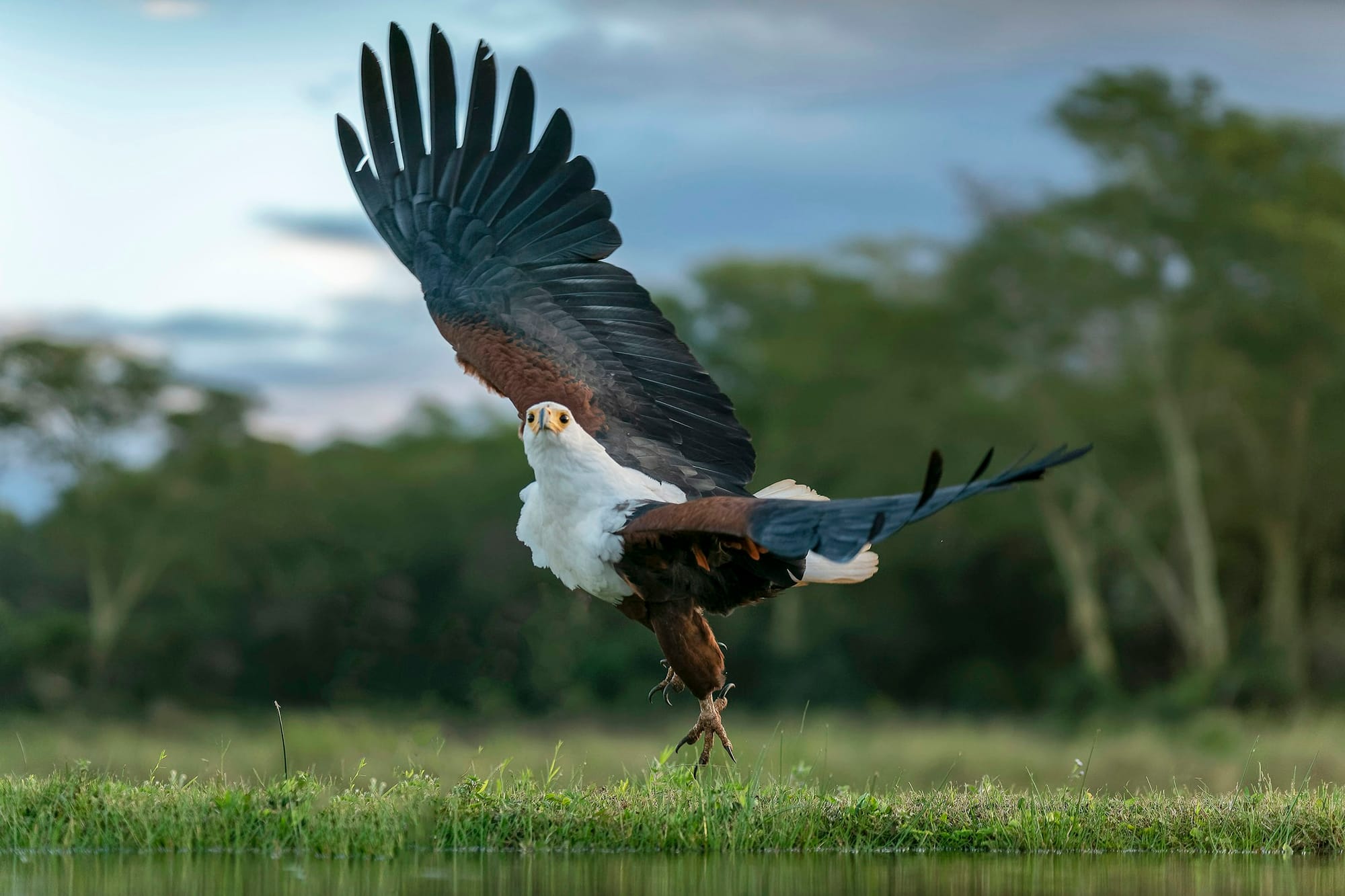
The park itself holds more than 400 recorded species across an unusually varied set of habitats. The Luangwa cuts through mopane woodland, riverine forest, ebony groves and open grassland in roughly a hundred kilometres, and the bird life shifts with each. African fish eagles are everywhere, calling from dead branches above the water. Saddle-billed storks patrol the lagoons. Yellow-billed storks gather in mixed flocks along the shallows. Southern ground hornbills walk the open ground in family parties, slow and deliberate, the loudest bird in the bush at dawn.
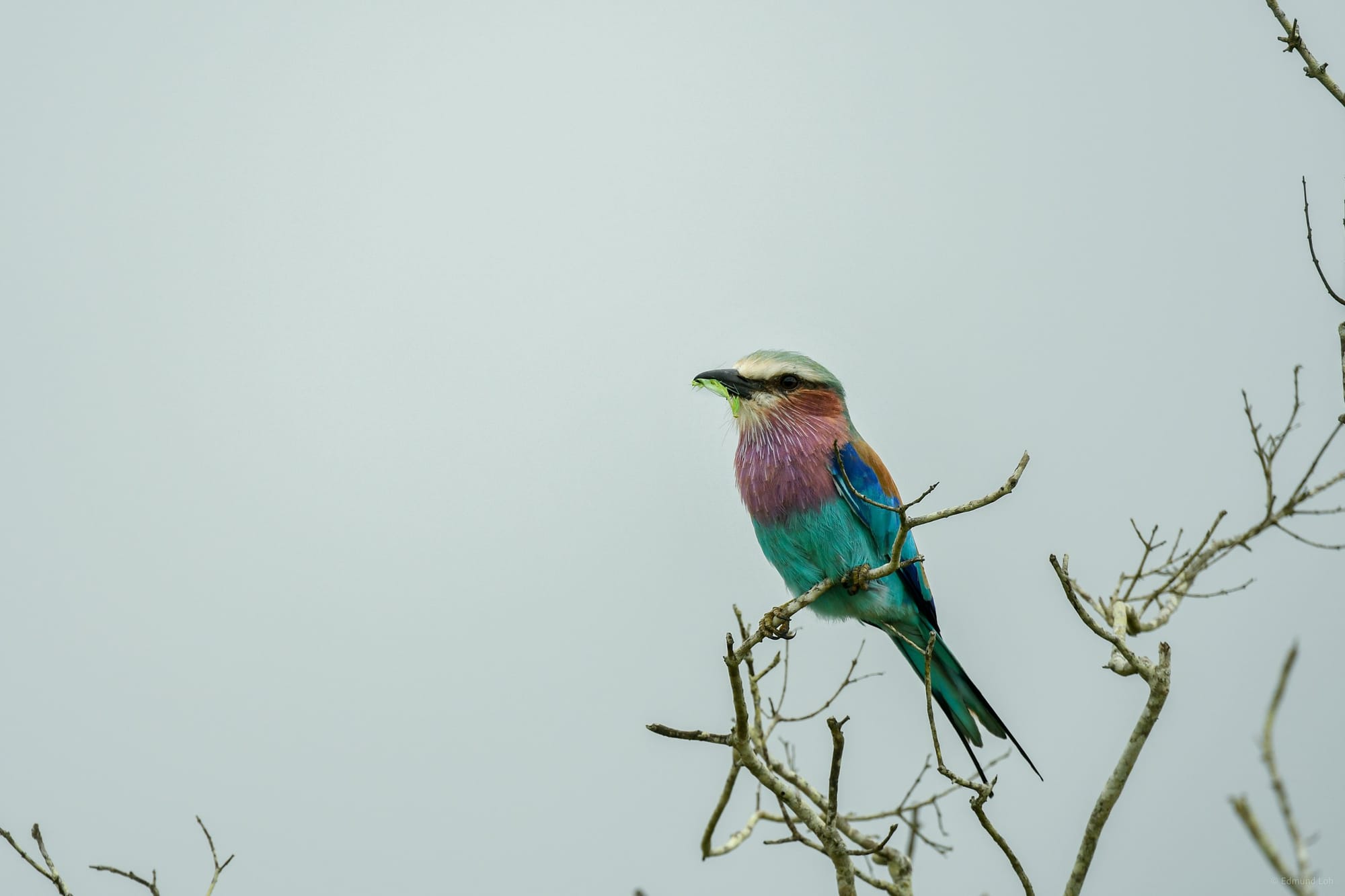
The lilac-breasted roller, which is most travellers' first really spectacular bird, sits on top of dead trees in the open woodland and refuses to be ignored. People photograph it badly for an hour, then well for the rest of the trip.
South Luangwa: the green season
From November through April, the Luangwa receives its rains and the bush changes character entirely.
Migratory species arrive in their thousands from Europe, Asia and across the African continent. European bee-eaters appear in mixed flocks with the residents. Woodland kingfishers, with their electric-blue wings and red-and-black bills, return to breed after months absent. Cuckoos call constantly, raptors shift their territories with the rains, and the canopy fills with movement. Many of these birds arrive in breeding plumage, which is when they look the way the field guides show them.
The trade-off is access. The dry-season tracks become impassable in places, some camps close between January and April, and the long grass changes the rules for big-game viewing. For a guest whose primary interest is birds rather than predators, the green season often produces the most dynamic week of the year. We have had clients describe it as the best safari they have done.
The walking safari heritage of the South Luangwa matters here. Norman Carr, who pioneered the model in this park decades ago, understood that walking changes what you notice. On foot you hear birds you would have driven past. You see the small things, blue waxbills, paradise flycatchers, sunbirds working acacia flowers. A morning walk in good company will do more for a casual birder's life list than a day in a vehicle.
The Lower Zambezi: the river as protagonist
If South Luangwa is the carmine bee-eater's park, the Lower Zambezi is the river's.
The Zambezi at this point is wide, slow and braided, cutting between the escarpment to the north and the floodplain to the south. The park holds more than 370 recorded species, with waterbirds and raptors particularly well represented. What changes the experience completely is the way you access them.
You can drive the Lower Zambezi, and game drives produce the woodland and savannah species you would expect. But the boat and the canoe are what most guests remember. A canoe safari at first light moves slower than walking, and on water at that hour the world is silent enough that every wingbeat carries. Malachite kingfishers, which are about the size of a sparrow and a colour that does not really exist anywhere else in nature, dart between reed beds. Hamerkops stand sentry on the half-submerged logs. Goliath herons, the tallest heron in the world, hold their pose for so long that you start to wonder if they are real.
The bird this park is known for is the African skimmer. It feeds in flight, dragging its elongated lower bill through the water as it flies, snapping shut on small fish that the bill makes contact with. Watching one feed is one of those moments when the form of an animal suddenly explains itself, the bill is not strange, it is the most efficient possible solution to the problem of catching small fish at speed in low light. The Lower Zambezi is the most reliable place in southern Africa to see this happen.
The other prize is Pel's fishing owl, a large, rust-coloured nocturnal owl that feeds almost entirely on fish and roosts in dense riverine forest. Some weeks a guide will find one without much effort. Other weeks it takes three or four attempts. Sightings are slow, careful work, and finding one is one of the things that experienced birders travel to the Lower Zambezi for.
Combining the two
Most of our Zambia trips are designed across both parks. They sit on different river systems, they fly easily from Lusaka, and the variety of habitat between them is what makes Zambia a destination rather than a single experience.
A standard shape runs four nights South Luangwa and three or four nights Lower Zambezi, with a one-night Lusaka stopover bookending the trip. Mfuwe (South Luangwa airport) is a one-hour flight from Lusaka. Royal Airstrip in the Lower Zambezi is thirty minutes. You do not need to plan around anything more complex than that.
Couples and small groups who want to extend will sometimes add Liuwa Plain or Kafue, both of which have their own arguments. For a first Zambia trip, the two-park combination is what we recommend.
The August window is the right time to see the carmine bee-eater colonies on the Luangwa side and to fly low over the Lower Zambezi while the river is still high enough to canoe properly. By October the Luangwa's water has dropped further, the bush is at its driest, and the river concentrates wildlife in remarkable density. By December the rains have arrived, the bee-eaters have left, and the trip is a different kind of trip again.
What to bring
A few things make the difference between a good birding week and a frustrating one.
A pair of binoculars in the eight by forty-two range. Not your mother's opera binoculars. The price-to-quality jump above two hundred dollars is significant, and a borrowed pair of decent binoculars from a friend who birds is better than a new pair of cheap ones.
A field guide. The Sasol Birds of Southern Africa is the standard. The Roberts app is excellent and runs offline. If you have neither and you want to start somewhere, the app is the easier purchase.
A camera with reach if you are photographing. Anything from 300mm upward will work for the larger birds. A 500mm or 600mm lens is what serious bird photographers carry, but most of our guests are not serious bird photographers, and the smaller lens is fine.
What you do not need is expertise. Our guides will work at any level, from "what is the difference between a stork and a heron" to "I think that's a Pel's call". They are accustomed to teaching. They will not embarrass you, and they are not bored by the basics.
The bush has been expecting you.
Frequently asked questions
When are the carmine bee-eater colonies on the Luangwa?
August to October. The colonies form when the birds arrive from breeding grounds further north in Africa and excavate nesting tunnels in the exposed sandbanks. Peak numbers are usually in September. By late October the colonies start to disperse as the chicks fledge and the rains build.
How many bird species are recorded in Zambia?
More than 750 across the country, with over 400 in the South Luangwa and over 370 in the Lower Zambezi. A two-park trip in good season can produce a hundred and fifty species or more for a moderately attentive observer working with a good guide.
Do I need to be a birder to enjoy this trip?
No. Most of our Zambia guests come for the wildlife generally and discover the birds along the way. The structure of the trip works for both. Game drives, walks and boat trips all produce mammals and birds in roughly equal measure. The level of birding attention is a dial you can turn up or down with your guide.
What is the difference between South Luangwa and the Lower Zambezi for birding?
South Luangwa has the carmine bee-eater colonies, the larger species count overall, the walking safari heritage, and the variety of woodland and grassland habitat. The Lower Zambezi is dominated by the river, with strong waterbird and raptor presence, and the canoe and boat access changes the experience entirely. Most birders prefer to do both.
Can you see Pel's fishing owl reliably?
Reliably is the wrong word. The Lower Zambezi is the most likely place in southern Africa to see one, and a guide with a known roost will increase your odds significantly, but it is not a guaranteed sighting. We tell guests to plan for the trip without it and to treat a sighting as a gift.
What is the best time of year overall?
For the carmine bee-eaters and dry-season game viewing, August to October. For migratory species and the most dynamic bird activity, the green season from November to April. April and May can be operationally difficult in the Lower Zambezi as the rains finish, and some camps close. We typically recommend the August to October window for a first Zambia trip and the green season for travellers who have been before.
Read next
If this resonated
The bush has been expecting you
Start with a conversation. We will ask what makes you want to wake up at four-thirty, and build from there.
Begin a conversation
Royal Malewane reopens: what we remember, and what the fact sheet confirms
The original Royal Portfolio property is back after months behind scaffolding. We haven't seen it yet. Here is what we know anyway.

We run on solar and we have not printed since 2019
Vikki and Sian on solar power, paper, and what a small safari company can honestly claim.

Sandringham Private Game Reserve: should you go early, or wait?
Greater Kruger's newest reserve opens in August 2026. Our honest take on who should book Sandringham early, and who should give it a few seasons.

The packing guide
What to bring on safari, what to leave at home, and the one thing no lodge can lend you. An honest packing list from the team in Hoedspruit.

How do you want to feel when you get home?
Why we plan safaris around how you want to feel when you get home, not around a pin on the map.

South Africa's online traveller declaration: what it means for your safari (and what it doesn't)
A five-minute customs form now stands between you and the arrivals hall. Here's what it is, who needs it, and what nothing to declare actually means for a normal safari guest.

Safari After Dark
Night drives reveal a different Africa. Quieter, older, more deliberate. Here's what we love about the bush after the sun goes down.

How we tailor every Marula Hill safari
We don't start with destinations. We start with you: your pace, your family, your idea of a good day in the bush.

When space teaches: what Saseka's refresh tells us about gathering in the bush
What a thoughtful safari lodge refresh tells us about gathering in the bush.

Inside FedAir's new Baobab lounge at Hoedspruit
The new Baobab lounge at Hoedspruit airport changes how a safari begins. Vikki Jackson on the room that holds you before the bush does.

How safari pricing actually works
From the people who build the quotes. What you are really paying for, where the money goes, and how to spend it well.

Monwana, and what coming home actually means
By Vikki Jackson and Sian Loehrer. A week at the Thornybush lodge that has built its whole identity around the word home, and what we found when we tested it against the room, the drives, the afternoons and the bill.

The Mozambique dhow: a slow boat at the end of a fast trip
Why we put a dhow afternoon into almost every Mozambique trip. Sail, salt water and the long breath out after safari.

Why we built the Antarctica page
A short note from Sian on why an African safari business added Antarctica to its destination map, and how we handle a trip neither founder has yet made.

Lion Sands Ivory Lodge. What their redesign gets right
I visited Lion Sands Ivory Lodge in the Sabi Sand. The redesigned spaces are quiet, bold, and rare. Here is what they got right.

Where the money actually goes on a luxury safari
A line-by-line look at what you're actually paying for on a luxury African safari — and what a quote that looks light is usually hiding.

Bazaruto vs Quirimbas: which Mozambique archipelago is right for you?
How to choose between Mozambique's two great archipelagos for a bush-and-beach trip. Geography, lodge feel, when to go.

Sabi Sand or Kruger
Two reserves, one fence line, very different mornings

What is the best month to visit Cape Town?
Cape Town rewards you differently in every season, but March to May is the window most of our clients come back to.

What Singita Lebombo's 2026 redesign tells us
Lebombo reopened March 2026 warmer, quieter, more art-led

Gorilla trekking, Uganda or Rwanda
Two countries, the same forest, two very different days

Do you need travel insurance for a safari
What safari travel insurance must cover, and why standard policies fall short

How two women from outside the travel industry built a luxury safari brand from Africa
We are the two women behind Marula Hill. One of us came from IBM, the other from MARS Southern Africa. Here is the long version of how a private safari business gets built from outside the travel industry.

Sole-use villa safaris in Africa
What sole-use villa safaris mean in practice, who they suit, and what to ask

Why Rwanda is the cleanest country in Africa
A plastic-bag ban from 2008. A mandatory community work morning on the last Saturday of every month. The system behind Rwanda's cleanliness, explained.