
What a day on safari actually looks like
A real walk through the hours of a safari day, from the pre-dawn knock on your door to dinner around the fire.

It starts in the dark.
There is a soft knock, barely audible, and then the smell of freshly brewed coffee drifting under the door. Outside, the bush is still black. The Lowveld has not woken yet. Somewhere close, a fiery-necked nightjar calls from a leadwood branch, and then nothing. Just the low creak of the cooling night air.
This is how a day on safari actually begins. Long before sunrise. Long before you are fully awake.
Pre-dawn coffee and the world before light
The knock comes around 5am on most private reserves, sometimes a few minutes earlier in summer when dawn breaks sooner. A tray of coffee and rusks appears outside your door, or you find it already laid on the veranda. Either way, you are standing outside in the dark with a warm cup, watching the sky begin to shift from black to the palest bruised purple.
This quiet window matters. Your tracker and guide are already out checking the roads, looking for fresh prints. The kitchen team has been up since before you. There is a whole machine moving around you while you sip your coffee and watch a bushbuck step out of the treeline, startled by nothing, then gone.
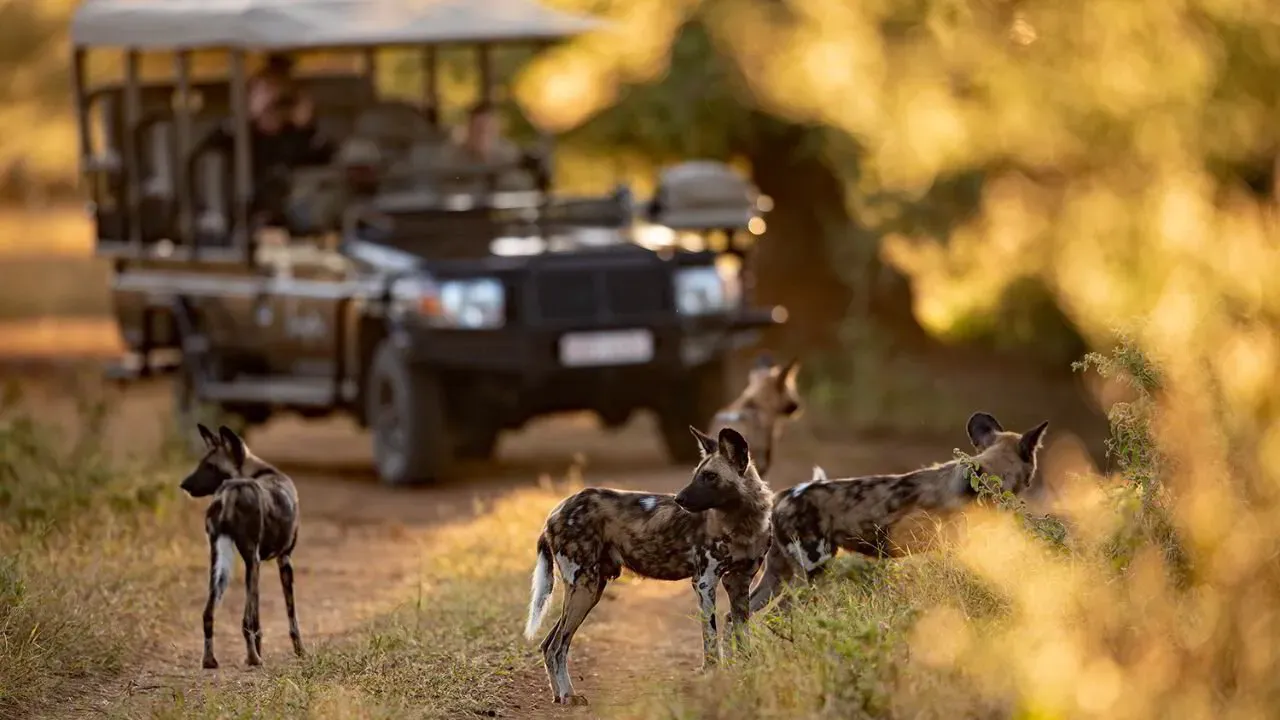
The morning drive
You are on the vehicle by 6am, and this is the window everything is built around.
Animals are most active in the coolest hours. Lions are still moving from a night hunt, sometimes with a carcass. Leopards are heading back to a favourite koppie before the heat gets up. Elephants are already on the road, which means your vehicle waits, engine off, for a matriarch and her family to pass a metre from the front seat. You feel it more than you hear it.
Your guide reads the bush in a way that takes years to learn. A fresh track pressed into dust. A section of grass that has been flattened and rolled in. Birds are suddenly silent over a drainage line. These are the clues that, to a first-time guest, look like nothing but open scrub. To an experienced guide, they are a map.
In Sabi Sand, morning drives often run three to four hours. You cover a lot of ground. The light shifts every twenty minutes, from that pale silver just before sunrise through to the hard gold of mid-morning. It is the best light for photographs, and the most beautiful time to be alive in the bush.
Most drives end with a bush stop, usually somewhere with a view. The tracker produces a flask of tea or coffee from a cool box, someone puts biscuits on the bonnet, and you stand in the middle of nothing, boots in the sand, watching the horizon go quietly gold.
Brunch back at the lodge
You return to camp around 9 or 10am. The table is already laid, and there is food. Proper food. Eggs cooked to order, fresh bread, something slow-cooked that someone has clearly been attending to since before you were awake. At most lodges in the Greater Kruger, brunch is the main meal of the day, and there is no reason to rush it.
This is also when you talk. You review the morning, identify what you saw out in the bush, figure out how the track you followed for forty minutes eventually led to what it led to. The stories are always better in the retelling.
Siesta
By 11am, the temperature starts to climb. By noon, the heat is serious.
Animals know this and act accordingly. Lions are flat under thorn trees. Leopards are invisible. Everything clever is in the shade, and you should be too. This is not a design flaw in the safari day. It is the point.
The midday hours are for doing nothing particularly useful. A swim. A long lunch served on the deck. A book you have been meaning to finish for two years. Some lodges offer bush walks after breakfast, which works because the guide knows exactly where to take you. But there is no pressure. The best guests we have ever worked with have mastered the art of sitting on a veranda with a cold drink and watching the world do very little.
High tea
Around 3pm, someone appears with tea and coffee, and whatever the kitchen has put out. This is the reset point of the day, the moment between the slow hours and the second drive. Guests who have been reading or sleeping start to stir. There is a particular quality of light at 3pm in the Lowveld that makes everything look like a painting, and the tea stop gives you a reason to be outside for it.
Your guide will often brief you on what came in over the radio during the afternoon. A cheetah coalition was spotted tracking impala on the eastern boundary. A female leopard was seen moving with a cub near the river. The afternoon drive has a direction before it even starts.
The afternoon drive
You leave camp around 3:30 or 4pm, and the bush is different now.
The temperature has dropped just enough. The light is lower and warmer. Animals that were invisible at noon are moving again. Elephants are heading toward water in family groups, the young ones half-running to keep up with the adults. If you are in leopard country, this is when you want to be in a drainage line with good tree cover, watching for the tail that hangs down from a branch.
The afternoon drive tends to run longer than the morning, sometimes stretching to four hours, depending on sightings.
Sundowners
Every afternoon drive ends in the field, not back at camp.
The guide finds a spot, usually elevated, usually with a view of open bush or a waterhole. The tracker produces a fold-out table, a cooler box, and whatever you want to drink. The sun goes down in the west and takes a very long time to do so. The sky runs from orange through a bruised purple that holds for longer than you expect.
You stand out there in the open with a drink in your hand, watching the sky, and it is the closest thing to pure stillness most people find in a year. No phone signal. No agenda. Just the sounds of the African bush.
Back through the dark
After sundowners, the drive back happens in the dark, and this is its own thing.
Your guide whips out a handheld spotlight, and the tracker works it slowly across the bush. Night is when you see creatures you will not see otherwise. A white-tailed mongoose moving through the undergrowth. A porcupine waddling away down the road. A genet freezing on a low branch with its eyes bright in the beam. If there is a leopard in the area, there is a real chance of seeing one on the move now. The same road you drove in daylight becomes something else entirely.
Dinner
Camp is lit when you return. There are lanterns along the path and a fire burning in the boma. The smell of wood smoke and whatever is coming out of the kitchen reaches you before the vehicle has even stopped.
Dinner on safari is not a quiet affair. It is the part of the day where everyone has something to say. The table around a boma fire tends to draw people in, and the conversation goes where it goes: the morning sighting, the afternoon, a question someone has been sitting on all day about why lions do a particular thing. The guides are often there, adding to it.
Food at the better lodges in Sabi Sand and the wider Greater Kruger tends to be serious. Not fussy, but considered. Local ingredients, a kitchen that has thought about what the evening calls for.
At some point, the fire drops to embers. Guests drift to their rooms. The bush, which had been quiet during the hottest part of the day, is alive again with night sounds. Frogs, cicadas, the distant whoop of a hyena. The fiery-necked nightjar is back on its branch.
Tomorrow, the knock comes at 5am.
If you are thinking about your first safari or want to get more specific about which reserve or lodge fits what you are looking for, we are easy to reach. We have planned a lot of these days, and we are happy to talk through the detail.
You might also want to read about when to go on safari in South Africa. The season shapes everything described above, from what you will see on each drive to how the mornings feel.
If this resonated
The bush has been expecting you
Start with a conversation. We will ask what makes you want to wake up at four-thirty, and build from there.
Begin a conversation
Royal Malewane reopens: what we remember, and what the fact sheet confirms
The original Royal Portfolio property is back after months behind scaffolding. We haven't seen it yet. Here is what we know anyway.

We run on solar and we have not printed since 2019
Vikki and Sian on solar power, paper, and what a small safari company can honestly claim.

Sandringham Private Game Reserve: should you go early, or wait?
Greater Kruger's newest reserve opens in August 2026. Our honest take on who should book Sandringham early, and who should give it a few seasons.

The packing guide
What to bring on safari, what to leave at home, and the one thing no lodge can lend you. An honest packing list from the team in Hoedspruit.

How do you want to feel when you get home?
Why we plan safaris around how you want to feel when you get home, not around a pin on the map.

South Africa's online traveller declaration: what it means for your safari (and what it doesn't)
A five-minute customs form now stands between you and the arrivals hall. Here's what it is, who needs it, and what nothing to declare actually means for a normal safari guest.

Safari After Dark
Night drives reveal a different Africa. Quieter, older, more deliberate. Here's what we love about the bush after the sun goes down.

How we tailor every Marula Hill safari
We don't start with destinations. We start with you: your pace, your family, your idea of a good day in the bush.

When space teaches: what Saseka's refresh tells us about gathering in the bush
What a thoughtful safari lodge refresh tells us about gathering in the bush.

Inside FedAir's new Baobab lounge at Hoedspruit
The new Baobab lounge at Hoedspruit airport changes how a safari begins. Vikki Jackson on the room that holds you before the bush does.

How safari pricing actually works
From the people who build the quotes. What you are really paying for, where the money goes, and how to spend it well.

Monwana, and what coming home actually means
By Vikki Jackson and Sian Loehrer. A week at the Thornybush lodge that has built its whole identity around the word home, and what we found when we tested it against the room, the drives, the afternoons and the bill.

The Mozambique dhow: a slow boat at the end of a fast trip
Why we put a dhow afternoon into almost every Mozambique trip. Sail, salt water and the long breath out after safari.

Why we built the Antarctica page
A short note from Sian on why an African safari business added Antarctica to its destination map, and how we handle a trip neither founder has yet made.

Lion Sands Ivory Lodge. What their redesign gets right
I visited Lion Sands Ivory Lodge in the Sabi Sand. The redesigned spaces are quiet, bold, and rare. Here is what they got right.

Where the money actually goes on a luxury safari
A line-by-line look at what you're actually paying for on a luxury African safari — and what a quote that looks light is usually hiding.

Bazaruto vs Quirimbas: which Mozambique archipelago is right for you?
How to choose between Mozambique's two great archipelagos for a bush-and-beach trip. Geography, lodge feel, when to go.

Sabi Sand or Kruger
Two reserves, one fence line, very different mornings

What is the best month to visit Cape Town?
Cape Town rewards you differently in every season, but March to May is the window most of our clients come back to.

What Singita Lebombo's 2026 redesign tells us
Lebombo reopened March 2026 warmer, quieter, more art-led

Gorilla trekking, Uganda or Rwanda
Two countries, the same forest, two very different days

Do you need travel insurance for a safari
What safari travel insurance must cover, and why standard policies fall short

How two women from outside the travel industry built a luxury safari brand from Africa
We are the two women behind Marula Hill. One of us came from IBM, the other from MARS Southern Africa. Here is the long version of how a private safari business gets built from outside the travel industry.

Sole-use villa safaris in Africa
What sole-use villa safaris mean in practice, who they suit, and what to ask

Why Rwanda is the cleanest country in Africa
A plastic-bag ban from 2008. A mandatory community work morning on the last Saturday of every month. The system behind Rwanda's cleanliness, explained.