
Wheelchair accessible safaris in Africa
A practical guide to wheelchair accessible safari destinations and lodges across Africa, from Kruger to the Okavango Delta.

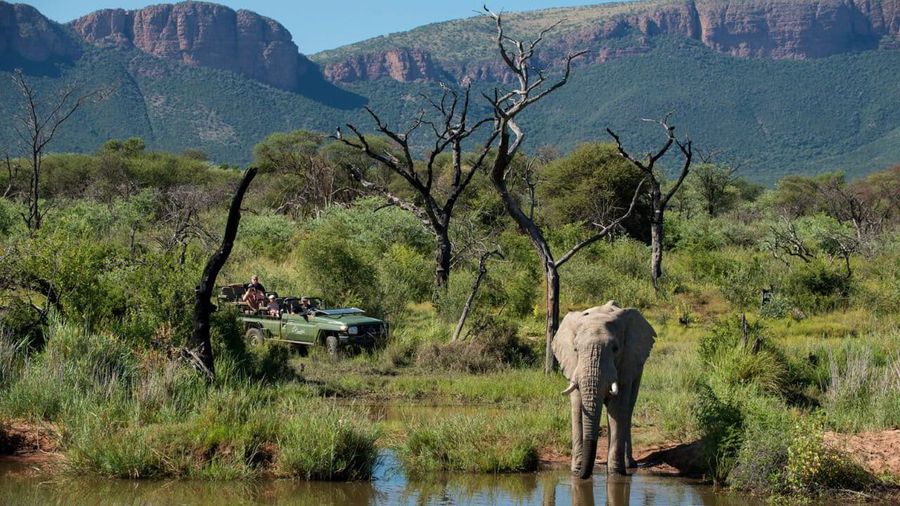
The game viewer stops at the edge of a dry riverbed. The dust settles. Across the sandy channel, two elephants move slowly through the mopane. Your guide cuts the engine and nobody speaks for a while. That moment has nothing to do with mobility. It is just the bush doing what it does.
Wheelchair accessible safari is possible, and in a growing number of destinations it is genuinely well-executed. What takes planning is not the experience itself but the logistics that get you there. This is what we tell clients who ask us: the gap between a good accessible safari and a frustrating one is almost always the detail in the planning stage.
Here is where things stand across the main destinations we work with.
South Africa: The Most Accessible Starting Point
South Africa has more purpose-built accessible infrastructure than anywhere else we work, and Kruger National Park is the obvious anchor.
Most of Kruger's roads are tarred, which matters enormously. Game viewing does not require rough terrain here. The park's larger rest camps, particularly Skukuza, Lower Sabie, Satara, and Mopani, all have accessible bungalows with roll-in showers and ramped access. Public areas at these camps, shops, restaurants, and viewing decks, are generally step-free. It is worth asking about specific units when you book: accessible rooms vary in size and some have baths rather than roll-in showers.
Private lodges adjacent to Kruger offer more control over the experience. Sabi Sabi Bush Lodge in the Sabi Sand has an accessible suite with grab rails and a hand-held shower nozzle, and their game drive vehicles have a seat beside the ranger with appropriate assistance for transfers. MalaMala, also in the Sabi Sand, has an accessible suite built to DPSA standards: no loose rugs, furniture at wheelchair height, and a wheel-in shower with full fittings. Land Rovers with a ramp to the front seat are used for game drives.
For the most purpose-built experience in South Africa, Ximuwu Safari Lodge in the Klaserie Private Nature Reserve (bordering Greater Kruger) is in a different category. It was designed from the ground up for wheelchair users, not retrofitted. Every suite is 100 square metres to allow full turning radius. Doors are over 100cm wide, floors are flush throughout, and there are no steps. Suites have electrically adjustable beds, roll-in showers with grab rails, hand-held shower heads, and a bath lift. The pool has a lift imported from Europe. Game drive vehicles are fitted with slide-out seats, custom ramps, and tie-downs. The airport transfer vehicle has a ramp and a BraunAbility swivel seat. Ximuwu also runs accessible photographic hides and offers a helicopter flight included in the stay, with a transfer board and mobile ramp for boarding. The lodge accommodates four to eight guests on an exclusive-use basis. It is 20 to 30 minutes from Hoedspruit airport.
East Africa: Solid Options With More Variables
The Serengeti and the Masai Mara are not built for wheelchair access in the way that South African lodges are, but there are specific properties worth knowing about.
In Tanzania, Four Seasons Safari Lodge Serengeti is the most consistently accessible option. Rooms, pathways, and dining areas are step-free, and the lodge can arrange adapted game drive vehicles. Wildlife at the Serengeti frequently crosses in front of the lodge itself, so meaningful sightings are possible without leaving the property.
In Kenya's Masai Mara, Angama Mara works with guests individually. Certain suites are accessible, and the team will arrange suitable vehicles for game drives on the plains. Given the escarpment setting, advance conversation about specific needs matters here.
The broader point for East Africa: properties vary more than in South Africa, and the level of accessibility depends heavily on which rooms and vehicles are available on specific dates. We always verify this directly before confirming a booking.
Botswana: Water-Based Viewing Changes the Equation
The Okavango Delta is one of our favourite accessible destinations, partly because the best wildlife viewing happens on the water. Boat safaris and mokoro (dugout canoe) trips move at a slow pace on flat water, which suits many travellers with mobility challenges far better than bumpy game drives.
Chobe Game Lodge on the Chobe River has wheelchair-accessible rooms and decks, and the boat safaris there are particularly good for hippo, elephant, and bird sightings. Access to the boats requires a short transfer, and the logistics depend on water levels at different times of year.
Okavango camp access is generally more variable than South Africa: many camps are reached by small bush plane, which involves a short walk across a grass airstrip and a step up into the aircraft. We check dimensions and loading procedures for each specific camp before confirming with any client who has mobility considerations.
What to Ask Before You Book
The questions that matter most are the ones that rarely appear in lodge brochures:
- What is the turning radius in the accessible room?
- Is the shower a roll-in or does it have a lip?
- How does the game drive vehicle transfer work, specifically?
- How steep is the ramp to the aircraft, and can equipment be stowed?
- Are portable ramps carried in the vehicle for bush stops?
We ask all of these on your behalf and in many cases we have visited the properties ourselves. Accessibility specifications on websites are often outdated or imprecise, and a room described as "wheelchair friendly" can mean anything from a grab rail in the bathroom to a fully purpose-built suite.
Planning a Trip Around Your Specific Needs
There is no single accessible safari that works for everyone. What works for a manual chair user may not work for a powered chair. A guest who transfers easily between surfaces has different requirements to someone who stays seated throughout. A client travelling with a carer needs different room configurations to a solo traveller.
The itineraries we put together for wheelchair users tend to start with a detailed conversation: what chair, what transfer ability, what equipment you travel with, and what you most want to see. From there we can match the right lodges, the right vehicles, and the right sequence of destinations.
If you would like to talk through what is possible for your trip, we are happy to work through the specifics with you.
If this resonated
The bush has been expecting you
Start with a conversation. We will ask what makes you want to wake up at four-thirty, and build from there.
Begin a conversation
Royal Malewane reopens: what we remember, and what the fact sheet confirms
The original Royal Portfolio property is back after months behind scaffolding. We haven't seen it yet. Here is what we know anyway.

We run on solar and we have not printed since 2019
Vikki and Sian on solar power, paper, and what a small safari company can honestly claim.

Sandringham Private Game Reserve: should you go early, or wait?
Greater Kruger's newest reserve opens in August 2026. Our honest take on who should book Sandringham early, and who should give it a few seasons.

The packing guide
What to bring on safari, what to leave at home, and the one thing no lodge can lend you. An honest packing list from the team in Hoedspruit.

How do you want to feel when you get home?
Why we plan safaris around how you want to feel when you get home, not around a pin on the map.

South Africa's online traveller declaration: what it means for your safari (and what it doesn't)
A five-minute customs form now stands between you and the arrivals hall. Here's what it is, who needs it, and what nothing to declare actually means for a normal safari guest.

Safari After Dark
Night drives reveal a different Africa. Quieter, older, more deliberate. Here's what we love about the bush after the sun goes down.

How we tailor every Marula Hill safari
We don't start with destinations. We start with you: your pace, your family, your idea of a good day in the bush.

When space teaches: what Saseka's refresh tells us about gathering in the bush
What a thoughtful safari lodge refresh tells us about gathering in the bush.

Inside FedAir's new Baobab lounge at Hoedspruit
The new Baobab lounge at Hoedspruit airport changes how a safari begins. Vikki Jackson on the room that holds you before the bush does.

How safari pricing actually works
From the people who build the quotes. What you are really paying for, where the money goes, and how to spend it well.

Monwana, and what coming home actually means
By Vikki Jackson and Sian Loehrer. A week at the Thornybush lodge that has built its whole identity around the word home, and what we found when we tested it against the room, the drives, the afternoons and the bill.

The Mozambique dhow: a slow boat at the end of a fast trip
Why we put a dhow afternoon into almost every Mozambique trip. Sail, salt water and the long breath out after safari.

Why we built the Antarctica page
A short note from Sian on why an African safari business added Antarctica to its destination map, and how we handle a trip neither founder has yet made.

Lion Sands Ivory Lodge. What their redesign gets right
I visited Lion Sands Ivory Lodge in the Sabi Sand. The redesigned spaces are quiet, bold, and rare. Here is what they got right.

Where the money actually goes on a luxury safari
A line-by-line look at what you're actually paying for on a luxury African safari — and what a quote that looks light is usually hiding.

Bazaruto vs Quirimbas: which Mozambique archipelago is right for you?
How to choose between Mozambique's two great archipelagos for a bush-and-beach trip. Geography, lodge feel, when to go.

Sabi Sand or Kruger
Two reserves, one fence line, very different mornings

What is the best month to visit Cape Town?
Cape Town rewards you differently in every season, but March to May is the window most of our clients come back to.

What Singita Lebombo's 2026 redesign tells us
Lebombo reopened March 2026 warmer, quieter, more art-led

Gorilla trekking, Uganda or Rwanda
Two countries, the same forest, two very different days

Do you need travel insurance for a safari
What safari travel insurance must cover, and why standard policies fall short

How two women from outside the travel industry built a luxury safari brand from Africa
We are the two women behind Marula Hill. One of us came from IBM, the other from MARS Southern Africa. Here is the long version of how a private safari business gets built from outside the travel industry.

Sole-use villa safaris in Africa
What sole-use villa safaris mean in practice, who they suit, and what to ask

Why Rwanda is the cleanest country in Africa
A plastic-bag ban from 2008. A mandatory community work morning on the last Saturday of every month. The system behind Rwanda's cleanliness, explained.