
Rovos Rail: an honest look at South Africa's luxury train
We've spent time aboard Rovos Rail. Here's our honest take on the cabins, the routes, the food, and whether it's worth the price.

The train pulls out of Rovos Rail's private station in Pretoria just after midday, and the city falls away almost immediately. Within twenty minutes, there is nothing but Highveld grassland outside the window, tawny and wide, the sky enormous above it. Someone hands you a glass of Chenin Blanc without you asking. You realise you have nowhere to be for the next three days.
That's the Rovos Rail experience, distilled.
We've been aboard, and clients ask us about it constantly. Is it worth the price? Which route? Which suite? What's the food really like? This is our honest take.
The train itself: what Rovos Rail actually is
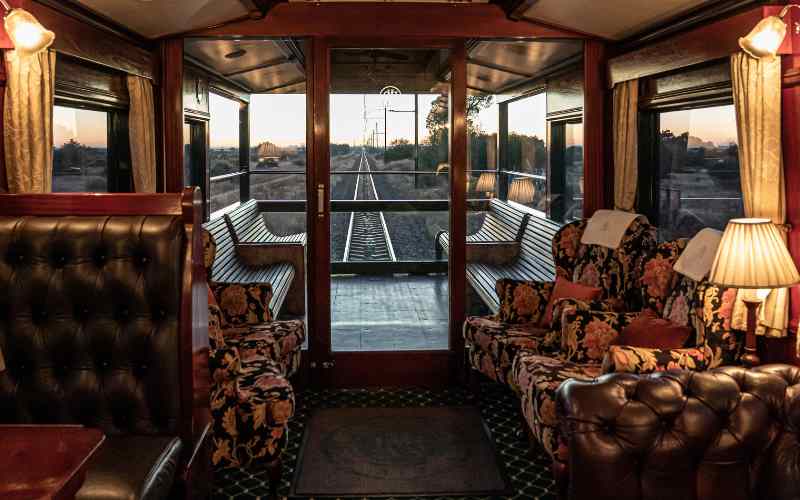
Rovos Rail was founded in 1989 by Rohan Vos, who spent years restoring vintage railway carriages from the 1920s and 1930s. The result is a working train that feels like a period film set: polished mahogany panelling, brass fittings, white linen tablecloths, and staff in period-style uniforms. There are no TVs in the suites, and there is no Wi-Fi anywhere. That is a deliberate choice, and most guests end up grateful for it.The train carries around 72 passengers at full capacity. It feels intimate. You eat with the same group each night, and by day two you tend to know people's names.
The suite categories
There are three categories: Pullman, Deluxe, and Royal.
The Pullman is the entry point. It's a compact cabin with a sofa that converts into a bed and a small bathroom with a shower. Comfortable, well-finished, but really quite small. If you're spending three or four nights aboard, we'd steer most clients away from it.
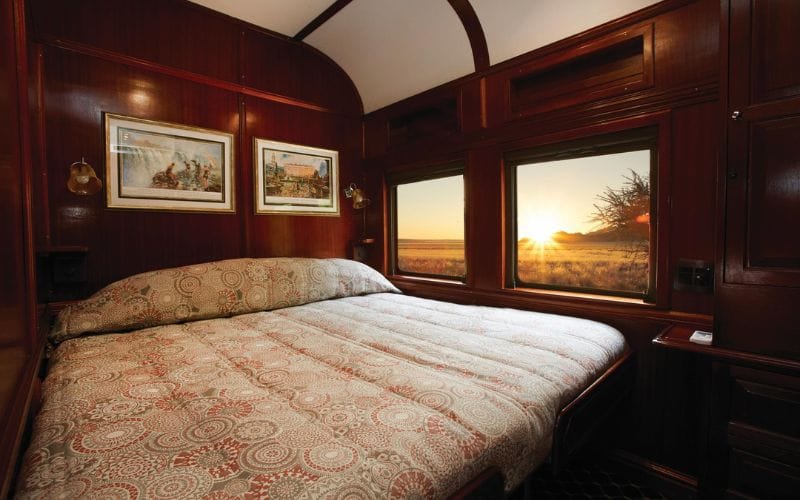
The Deluxe is where the train really starts to make sense. Larger windows, a proper double or twin bed configuration, and a decent en-suite with shower. The decor is the same (rich wood, brass, fine linens) but you have enough space to read a book at the window without your knees touching the wall. This is what we travelled in, and it worked well.
The Royal Suite takes up half a carriage and includes a Victorian-style bathtub. It's extraordinary for a moving train. Honeymoon couples and milestone birthday travellers tend to book it, and we'd say it's worth considering if the budget allows.
All suites are air-conditioned, have a stocked minibar personalised to your preferences, and include 24-hour butler service. The butler arrangement is discreet rather than formal. Your attendant is nearby when you need something and invisible when you don't.
The two main routes
Pretoria to Cape Town (3 nights)
This is the classic. About 1,600 kilometres over three days and two nights, departing Pretoria and arriving into Cape Town.
The train crosses the Highveld before dropping into the Great Karoo, one of the great landscapes of Southern Africa. The Karoo is semi-arid, ancient, and so quiet that you become aware of the train's sound in a new way. Wide sky, distant koppies, dry riverbeds. It goes on for hours and it doesn't get old.
There are stops along the way. Kimberley, once the centre of the diamond rush, is a brief excursion to the Big Hole, long billed as the largest hand-dug excavation in the world. Matjiesfontein is a perfectly preserved Victorian village in the middle of nowhere, slightly eccentric and worth the 30-minute walk around.
The final approach to Cape Town is a shift: the Karoo gives way to vineyards, then mountains, then suddenly the flat top of Table Mountain appears ahead of you. Arriving by train into Cape Town rather than by plane is a different experience entirely. You've earned the view.
Pretoria to Victoria Falls (3 or 4 nights)
The northbound route heads out of Pretoria through Limpopo, crosses the Tropic of Capricorn, then the Limpopo River, and enters Zimbabwe. The landscape changes dramatically: granite kopjes, mopane woodland, and the distinctive flatness of the Zimbabwean bush.
The 3-night version includes a guided game drive in Hwange National Park, which is known above all for its elephants. Large breeding herds are common, and in the dry season (May to October), the concentrations around waterholes can be extraordinary.
The 4-night option adds a half-day excursion into Matobo National Park, a UNESCO World Heritage Site of massive granite outcrops, ancient San rock art, and sweeping views. Cecil Rhodes is buried there, and most visitors to Zimbabwe miss it entirely. Worth the extra night.
Both itineraries include a 114 kilometre straight stretch of railway through the Zimbabwean bush without a single bend.
Arrival at Victoria Falls announces itself before you see anything. The mist rises above the trees in the distance. Mosi-oa-Tunya. "The Smoke That Thunders." The train pulls in slowly, and you step out into humidity and sound.
Food and drink
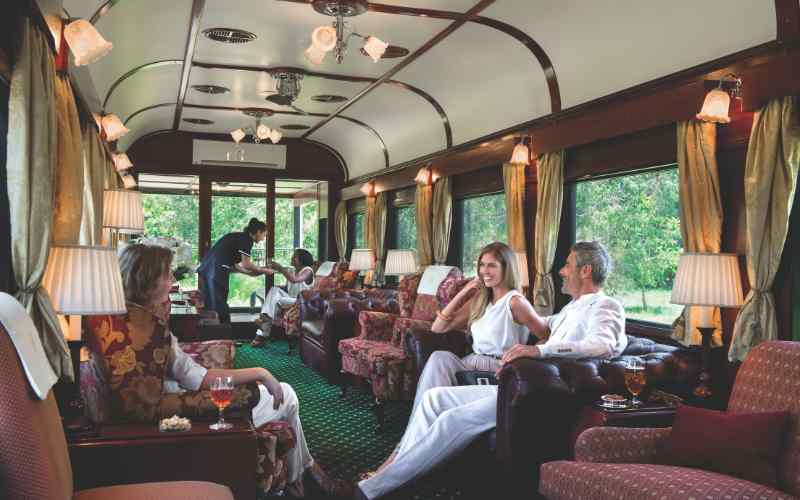
Meals are taken in the dining car at set times, and dinner is formal: jacket and tie for men, evening wear for women. This is not stubbornly traditional; it's more that dressing for dinner fits the theatre of the train, and most guests enjoy it.
The food is good. Chefs prepare menus daily using South African produce: springbok carpaccio, Karoo lamb with rosemary jus, and Amarula crème brûlée. The wine list is South African throughout and well chosen. There is a single meal sitting per service, so you eat with the same group each night, which tends to generate conversation.
Breakfast is more relaxed. Coffee, fruit, and eggs from the kitchen while the Karoo rolls past the windows. High tea is served in the lounge car in the afternoon.
The observation car
This is the social heart of the train, and it's where most passengers spend their time between meals.
The observation car sits at the rear of the train with open-air balconies on both sides and a covered lounge inside. You stand at the back rail and watch the track disappear behind you, the bush or the Karoo unfolding in all directions. Giraffes alongside the tracks are not unusual on the northern routes. Sunsets over the Karoo from the back balcony, with a drink in hand, are the kind of thing that ends up defining the trip in retrospect.
With no Wi-Fi to fill the silences, the observation car becomes a place where people actually talk. Books get read. Binoculars come out. By the second evening, the usual travel-acquaintance awkwardness is gone.
What about The Blue Train?
The Blue Train runs broadly the same Pretoria to Cape Town route and is worth knowing about if you're considering the options. It's a different tone: more contemporary hotel luxury than period romance. Sleek royal blue coaches, full bathtubs in suites, dedicated butlers, one notable stop in Kimberley. The experience is shorter (31 hours versus three nights on Rovos) and the atmosphere is less theatrical.
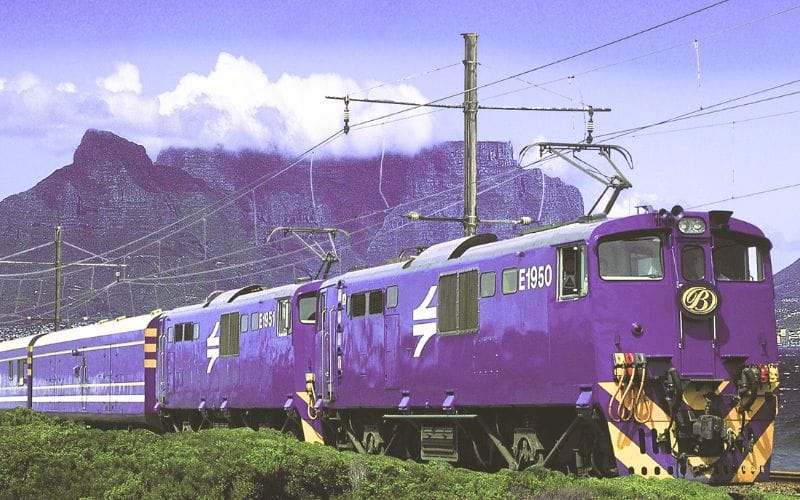
Our honest read: Rovos Rail is the better fit for travellers who want to feel situated in the landscape rather than passing through it. The Blue Train suits those who prefer a more conventional luxury hotel experience that happens to be on rails. Both are excellent at what they are.
One practical difference: Rovos Rail serves a single meal sitting; The Blue Train offers two. For sociable travellers who enjoy the shared table dynamic, Rovos has the edge.
Pairing the train with a safari
A train trip and a safari pair well, and we regularly plan them together.
The most natural combination on the Cape Town route is to fly from Cape Town to the Greater Kruger region after arriving by rail, spending a few nights at a private game lodge in the Sabi Sand. You arrive in Cape Town having seen the country from a train window at ground level; you then see it again from a game vehicle, at dawn, in a completely different context. The contrast is part of the appeal.
For the Vic Falls route, the options open up further. You can extend into Zimbabwe at one of the lodge properties near Hwange or the Zambezi, or cross into Botswana for the Okavango Delta. The northern route ends at one of the continent's great wildlife areas rather than a city, which lends itself naturally to this kind of extension.
Best time for the train: the dry season from May to October works for both the wildlife viewing component and for the train itself. The Karoo in winter light is particularly stark and beautiful. February and March bring the Cape wine harvest if the Cape Town arrival is the focus.
Is it worth it?
Yes, with conditions.
It's worth it if you have the time (three to four nights minimum), if slow travel appeals to you rather than just sounding good in principle, and if you go in a Deluxe suite or above. The Pullman is the one part of the Rovos Rail offering we'd hesitate to recommend for a multi-night trip.
It's also worth building into a broader South Africa or Southern Africa itinerary rather than treating it as a standalone. The train shows you the country at pace; a lodge stay gives you depth in one place. The two are more complementary than they are competing options.
If you'd like to talk through a Rovos Rail booking, whether that's the Cape Town route, the Vic Falls route, or something longer, get in touch with us. We've planned enough of these to know what works and what to avoid.
If this resonated
The bush has been expecting you
Start with a conversation. We will ask what makes you want to wake up at four-thirty, and build from there.
Begin a conversation
Royal Malewane reopens: what we remember, and what the fact sheet confirms
The original Royal Portfolio property is back after months behind scaffolding. We haven't seen it yet. Here is what we know anyway.

We run on solar and we have not printed since 2019
Vikki and Sian on solar power, paper, and what a small safari company can honestly claim.

Sandringham Private Game Reserve: should you go early, or wait?
Greater Kruger's newest reserve opens in August 2026. Our honest take on who should book Sandringham early, and who should give it a few seasons.

The packing guide
What to bring on safari, what to leave at home, and the one thing no lodge can lend you. An honest packing list from the team in Hoedspruit.

How do you want to feel when you get home?
Why we plan safaris around how you want to feel when you get home, not around a pin on the map.

South Africa's online traveller declaration: what it means for your safari (and what it doesn't)
A five-minute customs form now stands between you and the arrivals hall. Here's what it is, who needs it, and what nothing to declare actually means for a normal safari guest.

Safari After Dark
Night drives reveal a different Africa. Quieter, older, more deliberate. Here's what we love about the bush after the sun goes down.

How we tailor every Marula Hill safari
We don't start with destinations. We start with you: your pace, your family, your idea of a good day in the bush.

When space teaches: what Saseka's refresh tells us about gathering in the bush
What a thoughtful safari lodge refresh tells us about gathering in the bush.

Inside FedAir's new Baobab lounge at Hoedspruit
The new Baobab lounge at Hoedspruit airport changes how a safari begins. Vikki Jackson on the room that holds you before the bush does.

How safari pricing actually works
From the people who build the quotes. What you are really paying for, where the money goes, and how to spend it well.

Monwana, and what coming home actually means
By Vikki Jackson and Sian Loehrer. A week at the Thornybush lodge that has built its whole identity around the word home, and what we found when we tested it against the room, the drives, the afternoons and the bill.

The Mozambique dhow: a slow boat at the end of a fast trip
Why we put a dhow afternoon into almost every Mozambique trip. Sail, salt water and the long breath out after safari.

Why we built the Antarctica page
A short note from Sian on why an African safari business added Antarctica to its destination map, and how we handle a trip neither founder has yet made.

Lion Sands Ivory Lodge. What their redesign gets right
I visited Lion Sands Ivory Lodge in the Sabi Sand. The redesigned spaces are quiet, bold, and rare. Here is what they got right.

Where the money actually goes on a luxury safari
A line-by-line look at what you're actually paying for on a luxury African safari — and what a quote that looks light is usually hiding.

Bazaruto vs Quirimbas: which Mozambique archipelago is right for you?
How to choose between Mozambique's two great archipelagos for a bush-and-beach trip. Geography, lodge feel, when to go.

Sabi Sand or Kruger
Two reserves, one fence line, very different mornings

What is the best month to visit Cape Town?
Cape Town rewards you differently in every season, but March to May is the window most of our clients come back to.

What Singita Lebombo's 2026 redesign tells us
Lebombo reopened March 2026 warmer, quieter, more art-led

Gorilla trekking, Uganda or Rwanda
Two countries, the same forest, two very different days

Do you need travel insurance for a safari
What safari travel insurance must cover, and why standard policies fall short

How two women from outside the travel industry built a luxury safari brand from Africa
We are the two women behind Marula Hill. One of us came from IBM, the other from MARS Southern Africa. Here is the long version of how a private safari business gets built from outside the travel industry.

Sole-use villa safaris in Africa
What sole-use villa safaris mean in practice, who they suit, and what to ask

Why Rwanda is the cleanest country in Africa
A plastic-bag ban from 2008. A mandatory community work morning on the last Saturday of every month. The system behind Rwanda's cleanliness, explained.