
Ten days alone in Zimbabwe and Botswana. Why we keep recommending it
A 10-day solo female itinerary from Victoria Falls to Makgadikgadi and the Okavango Delta. Sian walks you through how we planned it.

The first thing Maria noticed at Victoria Falls was not the falls themselves. It was the mist. Before she'd even walked through the rainforest path, her clothes were wet and her face was cool and the roar was everywhere, coming from all directions at once, so loud she stopped trying to talk to her guide and just stood there.
That was day three. By day eight she was in a mokoro on the Okavango Delta watching a malachite kingfisher land six inches from the bow of the boat. She told us later she nearly forgot to breathe.
Maria came to us from Singapore. She'd been working hard for years and wanted something that was entirely for her. Not a group tour, not a cruise, not a hotel pool with swim-up cocktails. She wanted to go somewhere that would demand her full attention. We built her ten days, starting in Zimbabwe and ending deep in Botswana, and it's one of the itineraries we're most proud of.
Here's how it worked.
Victoria Falls, with room to just be in it
She arrived into Victoria Falls and transferred to The Victoria Falls Hotel, which is old colonial in the best sense: wide verandas, manicured gardens, staff who've been there long enough to know exactly when to be present and when to disappear. The views across to the Batoka Gorge are good from the room. Better after a gin and tonic at dusk.
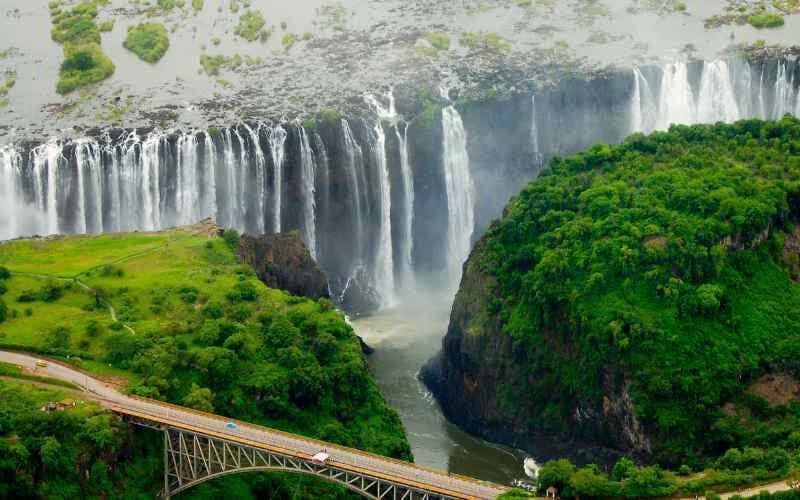
Day two was the falls themselves. Her guide walked her through the rainforest path that runs along the Zimbabwean side, from one viewpoint to the next, each one revealing a different section of the curtain. Mosi-oa-Tunya, in Tonga, means the smoke that thunders. Standing in the spray with the sound at full volume, you understand why that name stuck. In the afternoon she did the Flight of Angels, a helicopter ride that takes you above the gorge. Seeing it from the air (the river snaking in, the drop, the mist column rising) gives you a sense of scale that standing at the edge cannot.
We built day four as a free day. No guide, no schedule. She walked the town, wrote in her journal on the hotel veranda, had afternoon tea. Solo travel works best when there's space like that. Not every hour needs to be filled.
Into the Kalahari
On day five she flew into Botswana and crossed the salt pans by road to Camp Kalahari. The Makgadikgadi is not what most people expect from Botswana. There are no trees. The ground is flat and white and the horizon goes on further than feels reasonable. In the wet season, flamingos arrive. When we were there in the green season, the zebra migration was moving. Tens of thousands of animals raising dust against the afternoon sky.
Camp Kalahari does meerkats in the morning, which sounds gimmicky until you're crouched in the red earth at sunrise with a meerkat using your head as a lookout post. There are also San Bushman walks that Maria found more affecting than she'd expected. An hour on foot with a tracker who can read ground that looks completely blank to anyone else.
Evenings at Kalahari are good for stargazing. No light pollution out there. Night drives produce different animals: aardwolves, bat-eared foxes, spring hares bouncing across the track in the headlights.
The delta is a different world
Day eight was the flight into the Okavango Delta and the transfer by boat to Wilderness Little Vumbura. The camp sits on a private island in the northern reaches of the delta, and getting there by motorboat through the papyrus channels is its own experience. Little Vumbura is not a big camp. Six tented rooms, a pool overlooking the floodplain, a deck for star gazing in the evenings. The water and land are interchangeable here depending on the season, which means the wildlife is genuinely varied.
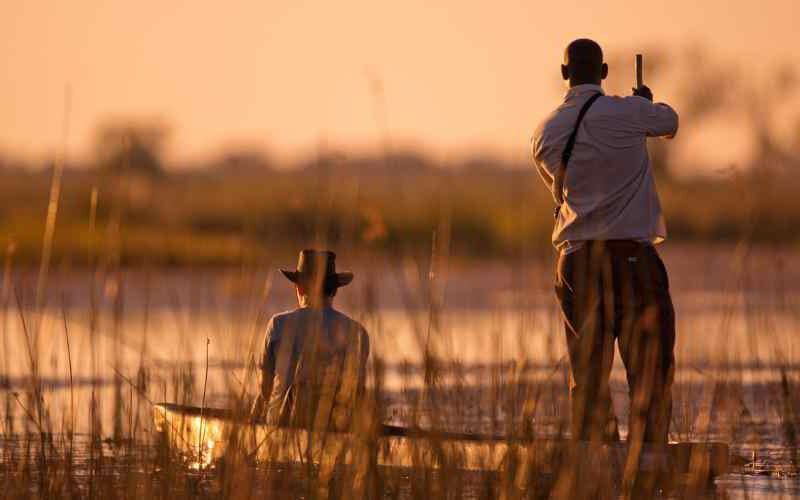
Maria's first afternoon was in a mokoro. Her poler was local, had grown up on the delta, and moved through the shallow channels with a long pole in near silence. There's something about the lack of engine noise that changes everything. You drift close to things you'd spook from a vehicle. Painted reed frogs on the stems. A fish eagle calling overhead. An elephant on the far bank, drinking.
The next two mornings followed the same pattern: out early for a game drive as the light came up gold over the grass, back for brunch, out again by boat in the afternoon. The game up there is good. The wild dog sightings in that concession are reliable in the right months. She saw lions on the first morning, a herd of sable in the late afternoon.
She told us on day ten, waiting for her transfer to Maun, that she hadn't once felt lonely. That surprised her. Solo travel is often sold on independence, but what made the difference was the quiet confidence that came from knowing every piece had been sorted. She could just be present.
What we built, and why
The Victoria Falls Hotel, Camp Kalahari, Wilderness Little Vumbura. These three properties give the trip its shape. Victoria Falls as the opening act, dramatic and historic. Kalahari as the contrast, spare and strange and nothing like what you'd imagine. The Okavango as the finale, green and intricate and slow.
The internal flights are short. The transfers are private. We handle the fast-track at Johannesburg for the connection home. From her side, it was ten days of showing up and being somewhere extraordinary.
This particular combination works for solo female travellers because the camps are small, the guiding is attentive without being crowding, and there's enough variety that the ten days never feel repetitive. It also works because Botswana as a destination is set up for it: low volumes, high-quality camps, and a wilderness that has not been overrun.
If any of this sounds like what you've been looking for, start with a conversation.
If this resonated
The bush has been expecting you
Start with a conversation. We will ask what makes you want to wake up at four-thirty, and build from there.
Begin a conversation
Royal Malewane reopens: what we remember, and what the fact sheet confirms
The original Royal Portfolio property is back after months behind scaffolding. We haven't seen it yet. Here is what we know anyway.

We run on solar and we have not printed since 2019
Vikki and Sian on solar power, paper, and what a small safari company can honestly claim.

Sandringham Private Game Reserve: should you go early, or wait?
Greater Kruger's newest reserve opens in August 2026. Our honest take on who should book Sandringham early, and who should give it a few seasons.

The packing guide
What to bring on safari, what to leave at home, and the one thing no lodge can lend you. An honest packing list from the team in Hoedspruit.

How do you want to feel when you get home?
Why we plan safaris around how you want to feel when you get home, not around a pin on the map.

South Africa's online traveller declaration: what it means for your safari (and what it doesn't)
A five-minute customs form now stands between you and the arrivals hall. Here's what it is, who needs it, and what nothing to declare actually means for a normal safari guest.

Safari After Dark
Night drives reveal a different Africa. Quieter, older, more deliberate. Here's what we love about the bush after the sun goes down.

How we tailor every Marula Hill safari
We don't start with destinations. We start with you: your pace, your family, your idea of a good day in the bush.

When space teaches: what Saseka's refresh tells us about gathering in the bush
What a thoughtful safari lodge refresh tells us about gathering in the bush.

Inside FedAir's new Baobab lounge at Hoedspruit
The new Baobab lounge at Hoedspruit airport changes how a safari begins. Vikki Jackson on the room that holds you before the bush does.

How safari pricing actually works
From the people who build the quotes. What you are really paying for, where the money goes, and how to spend it well.

Monwana, and what coming home actually means
By Vikki Jackson and Sian Loehrer. A week at the Thornybush lodge that has built its whole identity around the word home, and what we found when we tested it against the room, the drives, the afternoons and the bill.

The Mozambique dhow: a slow boat at the end of a fast trip
Why we put a dhow afternoon into almost every Mozambique trip. Sail, salt water and the long breath out after safari.

Why we built the Antarctica page
A short note from Sian on why an African safari business added Antarctica to its destination map, and how we handle a trip neither founder has yet made.

Lion Sands Ivory Lodge. What their redesign gets right
I visited Lion Sands Ivory Lodge in the Sabi Sand. The redesigned spaces are quiet, bold, and rare. Here is what they got right.

Where the money actually goes on a luxury safari
A line-by-line look at what you're actually paying for on a luxury African safari — and what a quote that looks light is usually hiding.

Bazaruto vs Quirimbas: which Mozambique archipelago is right for you?
How to choose between Mozambique's two great archipelagos for a bush-and-beach trip. Geography, lodge feel, when to go.

Sabi Sand or Kruger
Two reserves, one fence line, very different mornings

What is the best month to visit Cape Town?
Cape Town rewards you differently in every season, but March to May is the window most of our clients come back to.

What Singita Lebombo's 2026 redesign tells us
Lebombo reopened March 2026 warmer, quieter, more art-led

Gorilla trekking, Uganda or Rwanda
Two countries, the same forest, two very different days

Do you need travel insurance for a safari
What safari travel insurance must cover, and why standard policies fall short

How two women from outside the travel industry built a luxury safari brand from Africa
We are the two women behind Marula Hill. One of us came from IBM, the other from MARS Southern Africa. Here is the long version of how a private safari business gets built from outside the travel industry.

Sole-use villa safaris in Africa
What sole-use villa safaris mean in practice, who they suit, and what to ask

Why Rwanda is the cleanest country in Africa
A plastic-bag ban from 2008. A mandatory community work morning on the last Saturday of every month. The system behind Rwanda's cleanliness, explained.